

 Northern Norway – the Land of the Midnight Sun.
Northern Norway is the land of the Midnight Sun. After spending two delightful nights in Oslo, the capital of Norway, in August 2005, we flew SAS Scandinavian Airlines, to Kirkenes, which is as far north as Point Barrow, Alaska, and as far east as Istanbul and Cairo.
The landscape of Kirkenes was dotted with purple heather, the flower of Norway, as we traveled with our guide, Åse Utkilen, and our driver, Tor-Olaf Jacobsen, to the Pasvikvalley, which has Norway’s largest brown bear population. Fortunately, we did not see any bears. In addition to bear, the Pasvikvalley is also home to the white tailed eagle, golden eagle, lynx, capercaillie, roe deer, red fox and reindeer. This area was once very important to Norway, as it was the home of iron ore mines. In 1996 the mines closed due to low prices, but with the new rise in prices, negotiations are beginning, to reopen the mines. There are 4,000 lakes filled with pike, perch and trout in the municipality, and the borders of Russia, Norway and Finland meet in the Pasvikvalley. As such, the population is rich in cultural diversity with Norwegians, the Sami people, Russians and Finns.
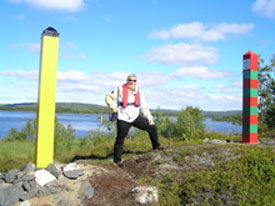
We took a Pasvikriver Cruise on a special 13 meter river boat with Arne Wikan, owner of Pasvikturist AS. It was an exciting trip as this is the closest area to Russia, and we could see the Russian border, and the yellow border markers in the river diving Norway and Russia. Since we did not have visas to visit Russia, we were unable to cross over to Russia, but we did visit a small island where markers divide the Norwegian and Russian borders, and we happily posed between the borders.
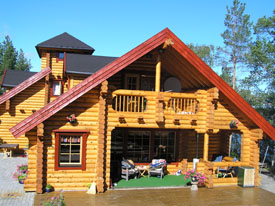 Afterwards, we had a delightful al fresco lunch of Arne’s salmon soup made with salmon, cubed potatoes, scallions, carrots and spices and enhanced with fresh cream, served with hot homemade rolls and butter, and accompanied by white wine, which was a perfect afternoon repast. We enjoyed our lunch sitting on wooden benches in the afternoon sunlight. It was an idyllic setting with the soup in a large black pot hanging over an open fire, with a backdrop of the Pasvikriver, Arne’s picturesque log cabin and the bright colors of nature.
Our next stop was to the National Park Senter in Svanvik, a botanical garden, where we strolled through their beautiful gardens and took several photographs of the flowers, followed by a trip to the Borderlandmuseum in Kirkenes where we climbed the Observation Tower to get a view of the Finnish and Russian borders. Along the way, we were excited to see reindeer on the hills.
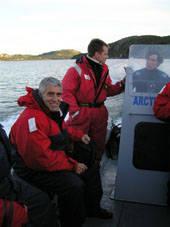 We completed our day in Kirkenes on a King Crab Safari at the Artic Adventure Resort. When we heard about a King Crab Safari, we were not exactly sure what it entailed, but as always we were game to try it. Imagine going on a “safari” on a zodiac boat along a fjord on the Barents Sea, wearing a bright red thermal flotation suit to search for king crab for dinner! We donned our suits, climbed into the zodiac and with co-owners of the Artic Adventure Resort, Captain Lars Petter, and Anton Kalinine dressed in scuba attire, we were off on an adventure. The largest king crab in the world can be found in these waters, and last year a fisherman caught a king crab weighing 11 kilos.
 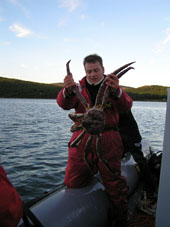 Although we are certified Divemasters, we did not dive, but rather just enjoyed the beautiful scenery, while Anton went in search of king crab for our dinner. Back on shore, a short time later we sat outdoors at a long pine table, and feasted on an incredible dinner of steaming hot king crab, which was the freshest crab we had ever eaten.
We returned to the city of Kirkenes and were thrilled to see that the sun was still shining at 1:30 am, and was still bright at 3:30 am even though the actual time of the Midnight Sun is from the 15th of May until the 28th of July.
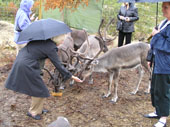 The next morning, we began our day with a trip to the Gabba Reindeer Safari Park, where we met with owner, Kåre Tannirk, and learned that only the Sami people can own reindeer. There have been reindeer keepers in Norway since the 1800’s, but only 6 Finn families are allowed to keep reindeer, besides the Sami. At present, there are 170,000 reindeer in Norway, and all the reindeer are earmarked to denote ownership. The Gabba Reindeer Safari Park has 5 reindeer, and serves as an educational facility.
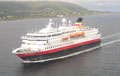 In the afternoon we embarked on a five-night cruise with the Norwegian Coastal Voyage on the ship, the MS Nordkapp, a 691-passenger ship that was built in 1996. The ship features many paintings by the famous Norwegian artist Karl Erik Haar (born in 1940), which tell the story of Norway, as well as by another famous Norwegian artist, Dagfinn Bakke.
On March 1, 2005, we met Her Majesty Queen Sonja of Norway at Scandinavian House in New York, and after her exciting photographic presentation, we decided that we wanted to experience Norway, and the majestic beauty of the fjords; the Norwegian Coastal Voyage trip is a great way to experience the breathtaking natural beauty of Norway.
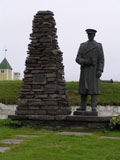 We settled our luggage into our cabin, explored the ship, had lunch in the restaurant, and then made our first stop at Vardø and visited the Vardøhus Fortress, which is world’s northernmost fortress, and was built between 1734 and 1738. It is an open-air museum open to the public from the 16th of April until the 15th of September from 10:00 am – 9:00 pm, and from the 16th of September until the 15th of April from 10:00 am until 6:00 pm. We returned to the ship in time to enjoy a leisurely dinner.
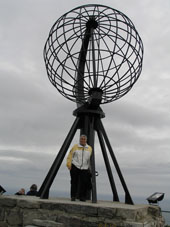 The next morning we arose early for an excursion to Honningsvag to the Nordkapp (North Cape), which is called the “Roof of Europe” and is situated at N. 71° 10’ 21” N. Latitude. We had breakfast overlooking the Artic Ocean, before taking a tour outside. The dramatic barren scenery was enhanced by strong gusts of wind, which helped contribute to the general wildness of the land. Afterwards we visited the displays, saw a film, and visited the gift shop.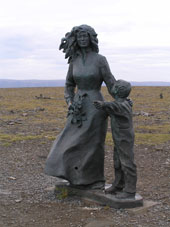
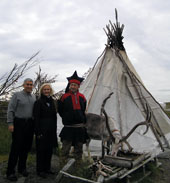 After we left Honnigsvag, we traveled through the rugged countryside of northern Finnmark, which is the home of the Sami population, and made a stop at a Sami shop. We rejoined our ship in Hammersfest, which is the world’s northernmost city.
Later that evening after dinner, the ship arrived in Trømso, which is the largest city of the Nordic countries north of the Artic Circle, where we disembarked to attend a midnight concert at the Artic Cathedral. Seated in the white stucco church, we noticed that the church had 3 icicle-like chandeliers down the center of the church, and also has one of Europe’s largest stained glass windows. The concert began with a saxophonist walking from the back of the church to the front, where he filled the church with a celebration of music, before he was joined by organ and then later, piano music. It was an uplifting and memorable evening in Trømso.
The next morning, we arrived at Harstad, and were off on another excursion, this time to take a sightseeing tour of the area with our guide, Harald Isachsen, as well as visit Trondenes and the Lofoten Islands. We began with a tour of Harstad, which celebrated its 100th anniversary in 2004. Harstad began with fisheries, and continued to grow in the 1860’s with herring fishing. By 1875, the herring had been fished out, but the area continued to grow. Today there are 23,000 inhabitants. The day was bright and sunny, but Harald, our guide, told us “there is no such thing as bad weather, only bad clothing”.
We visited the Trondenes Church, which was built around 1250. It is the northernmost stone church in Norway. The church has 3 alters with ornately carved figures, and during a restoration, 200-300 mummies were found below the black and ochre colored tiles on the floor.
We also visited the Trondenes Museum, where they had 4 paintings by the artist, Karl Erik Haar, whose paintings are prominently featured on the MS Nordkapp ship. They also had a bronze Viking necklace circa 500 BC, found by a dog digging a hole in 2001, as well as other Viking artifacts, a church room where items are on display from the Trondenes Church, and historical items from the war.
Trondenes has a strawberry as a municipality symbol, and in the summer they have 24 hours of sunshine, which result in large, sweet strawberries. We passed strawberry fields as well as potato and carrot fields, which are also very sweet as a result of the extra hours of sunlight. Although it was slightly past the height of the strawberry season, we bought strawberries that were deliciously sweet and ripe. Cloudberries, ‘Rubus chamaemorus’, a type of herbaceous raspberry, as well as blueberries and cranberries also grow in this region.
Although Norway is surrounded by the sea Norwegians don’t eat much shellfish; it is used as bait. Salmon farming is their 3rd largest export industry, with 400,000 metric tons exported annually, and as would be expected, salmon is very inexpensive in Norway. Norway is the largest exporter of fish in the world.
There are more than 83 different species of whales in the sea, including the Toothed Whale, which is the largest of the Blue Whales. There are Killer Whales, which come to feed on the herring in November and December, and divers can scuba dive with the Killer Whales, which are not as aggressive as the Pacific Killer Whale.
We took a ferryboat through the Eulles fjord, and enjoyed Norwegian specialties of waffles with goat cheese, cake spread with a cinnamon mixture, and lemon pound cake, which we savored with a cup of coffee on the short ferry ride. After we left the ferry, we traveled through the largest island in the area, Hinnoya.
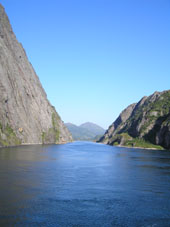
We returned to the MS Nordkapp, had lunch, and then lined up expectantly on deck seven as we entered the narrow, 2 km long Trollfjord, which is 100 meters wide at the mouth. The Trollfjord was a majestic site with its sheer cliffs rising out of the water. The MS Nordkapp is the only cruise ship that can maneuver through this narrow fjord, and the price of a passage is worth it just to be able to witness this breathtaking magnificence of nature. Although called the Trollfjord, we did not see any trolls, but we did hear that when there is a mist over the water, the elves and trolls are dancing.
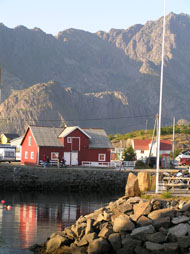 In the evening, we made one of our favorite stops to the fishing villages of the Lofoten Islands. We stopped in Henningsvaer, where the luminous bright sunlight was absolutely perfect for photography. The village was postcard-scenic with traditionally painted houses and buildings of red, yellow and white, along with the reflections of the colorful boats on the water. An interesting note about the color of the houses is that in the past, the color of a house indicated social status and wealth. Red was the least expensive to make, and was made with a mixture of rust, cod oil, animal blood and ox hide; yellow, made with a mixture of ochre and cod oil was for the middle class; and white, made from zinc and cod oil, was the most expensive, and for the wealthy. Sometimes just the front of the house was painted in a more expensive color, with the sides and back painted with a less expensive color. Although color no longer indicates social status, many people still paint their houses in the traditional colors.
The Lofoten Islands attract artists, divers and mountain climbers. There are cave paintings that date to 7,000 BC, and the area is home to moose, fox, otters, sea eagles, seals, dolphins, 110 types of sea life and 200 different species of birds in the summer. We visited the Galleri Karl Erik Haar, (born 1940), a prolific artist whose work we saw featured on the MS Nordkapp as well as the Trondenes Museum. We also passed wooden racks where stockfish (dried codfish) were hung to dry, which would later be sent to Italy, Spain, Portugal, South America and Africa. There are many sculptures in this municipality, as part of a sculpture landscape project.
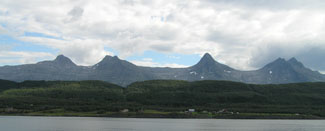 The next day, we sailed along the Nordland coast, and passed the stunning Seven Sisters peaks created by glaciers, which figure prominently in Norwegian legend, and the Artic Circle, located between Ornes and Nesna. When we stopped at Sandnessjoen, we disembarked for a quick stroll around this small town to take some photographs. Back on ship, we enjoyed the scenery, followed by dinner, before retiring for the evening.
In the morning, we took a sightseeing tour of the historic city of Trondheim, once a Viking settlement and the first capital of Norway. The Trondheim fjord is 120 km long, and is the 3rd largest fjord in Norway. It is an easy city to travel to; it has an international airport, as well as Trondheim Central Station where there are buses and trains. It receives around 5,000 – 6,000 ships all year, since its waters remain ice-free due to the gulf streams. Trondheim has 154,000 inhabitants, and is the 3rd largest city in Norway, (Oslo, Bergen, Trondheim). The city boasts having the Royal Residence, the largest sundial in the world, and its hospital was founded in 1277. Trondheim is also a cultural center with 3 concert halls and a symphony.
For the sports enthusiast, Trondheim is the perfect place to practice ski jumping, because in addition to having snow from mid-November to mid-March, their ski jumps are accessible year-round, as they cover the jumps with ice in summer. There are also 2 skating rinks, but skiing is the sport most preferred by Norwegians. Golf courses are being built, and are increasing in popularity. Another of Trondheim’s claims to fame is that the actress Liv Ullman is from Trondheim.
We visited the Nidaros Cathedral, built in 1070 AD, an amazing façade covered with statues, including those of Adam and Eve, saints, prophets and kings. A large rosette window dominates the center and is made of 10,000 pieces of glass. Like many churches, there are many gargoyles, but what is different about these gargoyles is that some are animals and some are people. Nidaros Cathedral has been the setting of royal weddings and coronations; the last coronation took place in 1906. Inside, the stained glass windows are called “the poor man’s bible” because the windows depict stories from the bible. Unfortunately, the original windows were destroyed in many fires, but the replicas are exquisitely done.
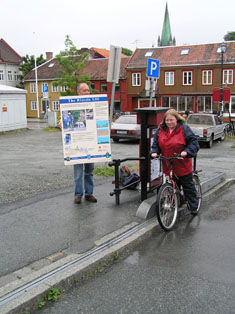 Norwegians are proud inventors whose inventions include the paper clip and the cheese slicer, but a recent invention in Trondheim really appealed to us. A Trondheim man built a Bicycle Lift, and claims that it is the only one in the world. Bicyclists remain seated on their bikes and put their right foot in a boot, whereby a mechanism pulls them uphill. Imagine not having to ride your bicycle up steep hills again!
The next day, we met with Kaakon Larsen, the ship’s Tour Guide, and Roy Stokvik, the Safety Officer, and took a tour of the bridge, where we learned that the MS Nordkapp cruises at a normal speed of 14.5 knots, uses 1,050 liters of diesel per year, and the depth of the water can range from 7 to 700 meters. We arrived at Bergen, said good-bye to our new friends, Rui and Ana Costa from Portugal, and disembarked the MS Nordkapp with wonderful memories and incredible photographs of the spectacular natural beauty we had experienced with the Norwegian Coastal Voyage.
Read our Bergen, Norway article in Destinations, as we continue exploring Norway!
For more information on Norway, please visit: www.visitnorway.com, www.invanor.no, www.kirkenesinfo.no, www.visitbergen.com and www.norwegiancoastalvoyage.us.
© November 2005. Luxury Experience. www.LuxuryExperience.com. All rights reserved.
